


Course details
Confined Space Safety - US
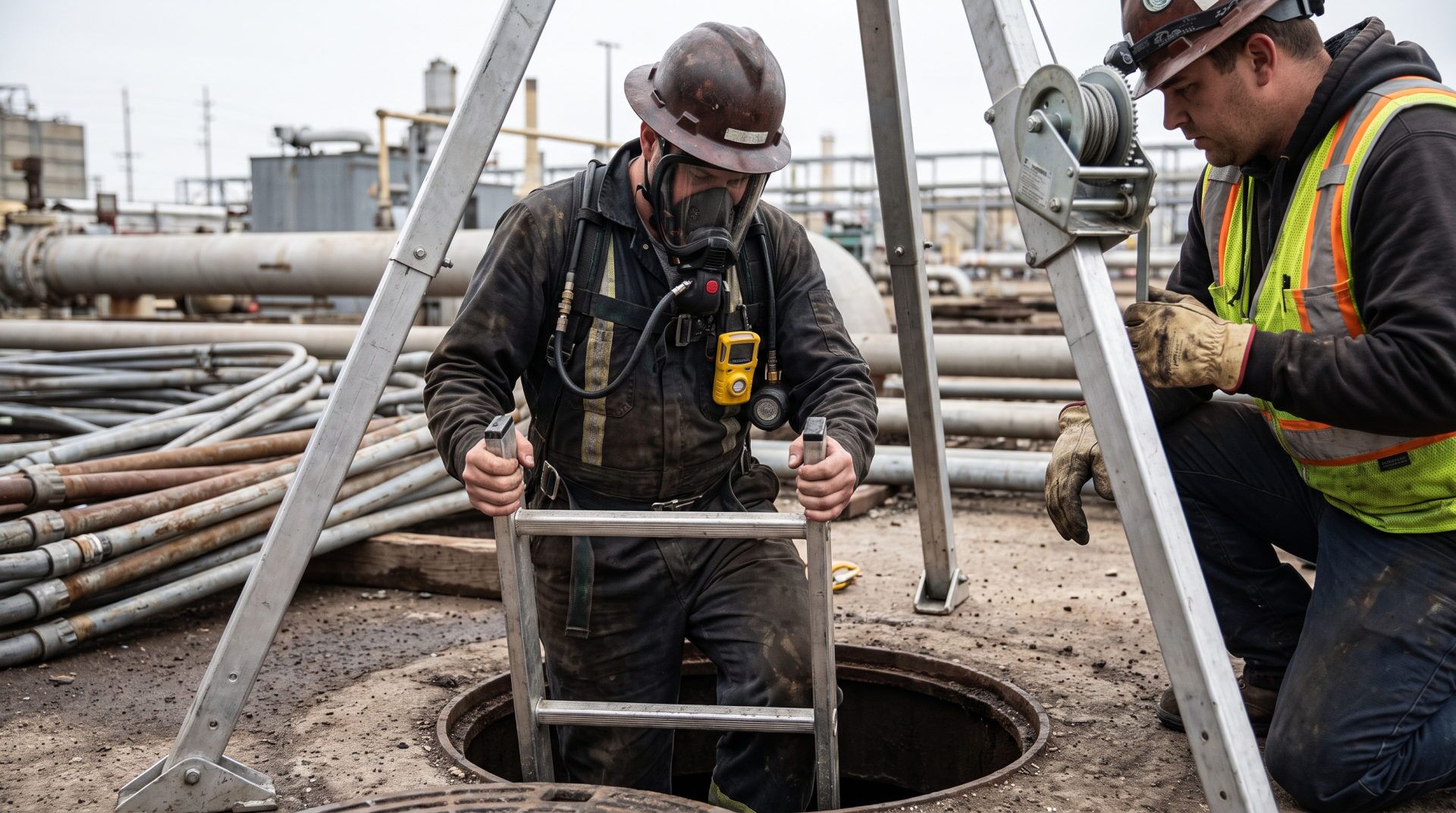
Workers who enter or work near confined spaces can face hazards that leave almost no time to react. Toxic atmospheres, oxygen-deficient air, and engulfment risks leave no room for guesswork. This confined space safety training course is structured around OSHA standard 29 CFR 1910.146, covering permit systems, team roles, atmospheric testing, and emergency rescue procedures in approximately 60 minutes.
If your job brings you near permit-required confined spaces, this course gives you the tools to identify hazards, apply the hierarchy of controls, fulfill your role on the entry team, and act correctly when conditions change.
Course Overview
This confined space entry training course is organized into learning modules that address the key stages of safe confined space work as defined by OSHA 29 CFR 1910.146. The modules are:
- Defining confined spaces and permit-required confined spaces
- Applicable OSHA legislation (29 CFR 1910.146)
- The confined space team: employer, authorized entrant, attendant, and entry supervisor
- Pre-entry preparation and confined space permits
- Atmospheric testing and monitoring
- Working safely in a confined space
- Hazards and the hierarchy of controls
- Personal protective equipment
- Emergency response and rescue
- Self-rescue, non-entry rescue, and entry rescue
Each module follows the sequence that OSHA 29 CFR 1910.146 prescribes for a confined space entry team. You move from classifying the space and confirming personnel, through hazard assessment and permit completion, to working inside the space and getting out fast when conditions demand it.
The final module on rescue options gives you a clear decision framework before an emergency forces the choice between self-rescue, non-entry rescue, and entry rescue.
Confined space incidents follow predictable gaps in preparation: permit, team, atmosphere, and rescue plan.
What You'll Learn
This confined space online training is aligned with the OSHA 29 CFR 1910.146 framework, from classifying a space to executing a rescue.
Confined space definitions
- Identify what qualifies a space as "confined" under 29 CFR 1910.146 and describe the physical features that distinguish a permit-required confined space from a general confined space.
- Describe the conditions, limited entry and exit, not designed for continuous occupancy, that trigger permit requirements and additional controls.
Team roles and responsibilities
- Identify the four roles OSHA 29 CFR 1910.146 defines for a confined space entry team: employer, authorized entrant, attendant, and entry supervisor.
- Describe the specific duties each team member carries before, during, and after entry so no responsibility falls between roles.
Pre-entry procedures and atmospheric testing
- Explain the preparation steps that OSHA 29 CFR 1910.146 requires before any worker crosses the threshold of a permit-required confined space.
- Apply atmospheric testing and monitoring protocols to evaluate whether conditions inside the space are safe for confined space entry.
Hazard recognition and PPE selection
- Identify the categories of hazard present in confined spaces, atmospheric, engulfment, entrapment, and others, and match each to the appropriate control in the hierarchy.
- Evaluate which personal protective equipment is appropriate for a given confined space entry based on the hazards identified.
Emergency response and rescue options
- Describe the emergency response measures that OSHA 29 CFR 1910.146 requires to be in place before entry begins.
- Compare self-rescue, non-entry rescue, and entry rescue so you can recognize which option applies to a given emergency scenario.
Assessment and completion
- Demonstrate knowledge of confined space safety course content by achieving the 80% pass mark on the final assessment to earn your certificate of completion.
Knowing the rules is the entry ticket. Knowing your role keeps you out of the incident report.
Who Should Take This Course?
- Authorized entrants who will physically enter a permit-required confined space and need to understand their rights, responsibilities, and when to self-rescue as defined under OSHA 29 CFR 1910.146.
- Confined space attendants who monitor conditions from outside the space and must recognize when to abort an entry and initiate rescue.
- Entry supervisors who sign the permit, verify pre-entry conditions, and carry authority to cancel an entry if hazards change.
- Maintenance and facilities workers whose routine tasks, tank cleaning, sewer inspection, utility vault access, regularly bring them near permit-required spaces.
- Health and safety coordinators who develop confined space programs, audit permit systems, and verify that team members hold documented training.
- New workers in industrial or construction environments who benefit from foundational confined space hazard knowledge before site-specific training and practical evaluation begin.
Why Take This Course?
Confined space hazards are invisible. An oxygen-deficient atmosphere looks identical to breathable air. Toxic gas concentrations can incapacitate a worker before a single symptom appears.
OSHA 29 CFR 1910.146 sets the standard. The regulation covers space classification, permit systems, atmospheric testing, and rescue planning. This confined space safety course is built directly around that standard, so you work through each requirement in the order it applies on the job.
Untrained rescuers become victims. Rescue attempts by co-workers without proper confined space entry training account for a significant share of confined space fatalities. Knowing the difference between non-entry rescue and entry rescue, and when each applies, protects the rescuer as much as the person in distress.
Documented training supports your confined space program. Organizations that record worker training against a recognized regulatory standard build an auditable file that holds up during permit reviews, incident investigations, and site inspections.
Key Benefits
- Certificate of completion included. A shareable credential documents your confined space safety training against OSHA 29 CFR 1910.146 for personnel files, permit audits, and site records.
- Rescue decision errors avoided. You leave with a clear, three-option rescue framework, self-rescue, non-entry rescue, entry rescue, that prevents the untrained bystander response responsible for secondary fatalities in confined space incidents.
- 60-minute online, self-paced format. The entire confined space entry training completes in a single session with no travel, no scheduling coordination, and no classroom booking required.
- Regulatory knowledge that transfers across sites. The course is grounded in the federal OSHA standard 29 CFR 1910.146, so the framework applies wherever that standard governs, not only at a single facility.
- Priced at $69.99 per learner. A fixed, per-seat cost with no subscription or seat minimum makes it straightforward to budget for individual workers or small crews.
Topics Covered
Course Details
- Duration: 60 minutes
- Format: Online, self-paced
- Pass mark: 80%
- Certificate: Certificate of completion included upon passing
- Price: $69.99 per learner
- Regulatory alignment: OSHA standard 29 CFR 1910.146, Permit-Required Confined Spaces
Frequently Asked Questions
How long does the confined space safety course take to complete?
The Confined Space Safety - US course is 60 minutes. You can complete it in a single session with no breaks required.
What score do I need to pass the confined space entry training?
You need 80% or higher on the final assessment. Workers who do not reach that threshold can review the material and retest.
Is a certificate included when I complete the confined space course?
Yes, the Confined Space Safety - US course includes a certificate of completion for every learner who passes the 80% assessment. You can file it alongside site-specific permit records.
What does this confined space training course cost?
The course is $69.99 per learner. There is no subscription, no seat minimum, and no additional fee for the certificate.
Who should take this confined space safety training?
Authorized entrants, attendants, entry supervisors, maintenance and facilities workers, health and safety coordinators, and any worker whose job brings them near permit-required confined spaces should take this course.
Which OSHA standard does this confined space course cover?
The course is built around OSHA 29 CFR 1910.146, Permit-Required Confined Spaces. It covers space classification, permit systems, team roles, atmospheric testing, hazard controls, PPE selection, and all three rescue options.
This course takes approximately 60 minutes to complete
A passing grade of 80% or higher required. Up to 3 attempts are provided.
A certificate will be provided upon the successful completion of this course
